


What makes a perfect kite spot (and why most spots fall short)
Updated: Aug 18
Kitesurfing is a sport where your progress depends on more than just a good instructor and solid gear — it depends on where you actually get in the water. A perfect kite spot is one where you're not fighting the elements the whole time: the wind, the seabed, and the shoreline are all working with you, not against you. Here's what that actually looks like, point by point, and what happens when a spot misses the mark.
The five ingredients of a perfect kite spot
1. Reliable wind — at least 200 windy days a year Wind is a kite's natural habitat. If a spot gets fewer than 200 windy days a year, you're taking a real gamble: you could fly out for your trip and simply not get wind, or get just enough to start a kitesurfing course but not enough to finish it. Steady, predictable wind for most of the year is the first thing worth checking before you book a kite school or plan a trip.
2. Wide shallow water — at least 200 meters Learning with your feet on the bottom is dramatically easier than learning in deep water. A kite is pulling on you constantly, and if you don't have solid footing, all your energy goes into just staying afloat — there's nothing left for actually learning proper kite control.
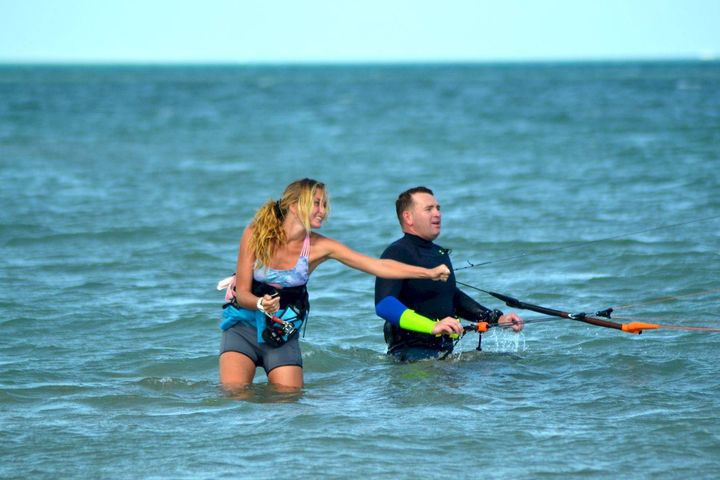
There's a second, more practical reason the shallows need to be wide: kiters simply need room. Kite lines run 20-25 meters long, which means riders need at least 50 meters of space between each other to avoid tangling lines. On a narrow shallow strip with several students and riders sharing the water, you just can't fit that spacing in — and the risk of a line wrap or a collision goes up fast. A wide, shallow lagoon buys you both things at once: time to work on technique, and enough room to do it safely alongside other riders. That combination is what actually speeds up progress.
3. A sandy bottom Rocks, coral, or shell debris on the lagoon floor are a common source of injuries — from bad water starts, falls, or simply walking out with your gear. A soft, sandy bottom removes most of that risk and makes falling safe, which matters, because when you're learning to kitesurf, you fall a lot.
4. Side-shore wind Wind direction is a genuine safety issue, not a minor detail. Onshore wind (blowing straight at the beach) raises the risk of getting dragged into the shore. Offshore wind (blowing straight out to sea) can pull a kiter out into deep water, where getting back on your own is hard — it costs time, energy, and sometimes turns into an actual rescue. Side-shore wind, blowing parallel to the beach, is the gold standard: predictable, forgiving, and far more comfortable to ride in.
5. No obstacles downwind If there's a hard structure — a pier, rocks, a building, power lines — within 200 meters downwind of the launch spot, that spot shouldn't be ridden at all. This isn't about comfort, it's about survival: if you lose control of the kite, it can pull you straight toward that obstacle, and the outcome can be fatal.

What happens when a spot falls short
Each of these five factors isn't a nice-to-have — skipping any one of them directly cuts your odds of actually learning to kitesurf, and raises your odds of getting hurt:
Not enough wind → a wasted trip, or a course you never finish.
Narrow shallow water → wasted energy, slower progress, constant line-tangle risk.
Rocky or hard bottom → cuts, bruises, foot injuries.
Wrong wind direction → dragged onto the beach or swept out to sea — a genuine safety risk.
Obstacles downwind → a critical, non-negotiable risk that rules the spot out entirely.
The takeaway
A perfect kite spot isn't a marketing line — it's a set of specific, measurable conditions: wind at least 200 days a year, shallow water at least 200 meters wide, a sandy bottom, side-shore wind, and a clear zone of at least 200 meters downwind of the launch. Playkite checks every one of these boxes — which is why it's a spot where you can learn to kitesurf without unnecessary risk, spending your energy on progress instead of on fighting the conditions.
WhatsApp or Telegram Alexander
+201205965076


Comments