


What Beginners Should Expect From Kitesurfing Lessons
Updated: Aug 18
Before you ever step on a board or feel the kite's first pull, it helps to know what the learning process actually looks like — what's required of you, and what isn't.
No Wind, No Kiteboarding
Kitesurfing runs on wind. No wind means no lift, no power, and no reason to be out on the water. So the first thing to accept: your lesson schedule follows the forecast, not your calendar.
The usable wind range is 6 to 15 m/s (roughly 13–34 mph). Ideal conditions for learning sit at 8–10 m/s (18–22 mph).
Below 6 m/s — the kite just won't fly properly. There isn't enough power to keep it stable in the air, let alone pull you across the water.
Above 15 m/s — now you're in truly extreme territory. 15 m/s is close to 30 knots, and at that strength a kite can accelerate you to wind speed in about a second. The cost of a mistake jumps to a level that's simply not worth it for a beginner.
If there's no wind on a given day, it's not a wasted one. A couple of hours of solid classroom time — gear, safety procedures, what to do when things go wrong — pays off later, since every minute of good wind on the water is too valuable to spend explaining basics.

Who Kiteboarding Is For
Gear is built for riders weighing 40 to 125 kg (about 90–275 lbs). Students range from age 8 to 80. No particular fitness level is required — people with wildly different physical backgrounds learn to kiteboard.
There's a catch, though, and it's not the one people expect: physical effort isn't the main challenge here. Focus is.

Your Hands Steer — They Don't Hold On
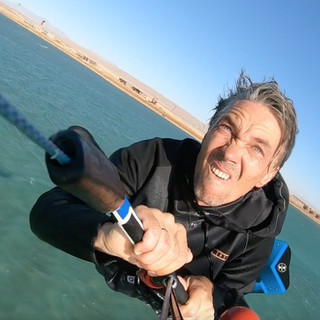
One of the most important things to grasp early: the kite's pull loads onto the harness hook, not your arms. You're not supposed to hold anything with your hands.
Your body weight is the counterbalance holding the whole system against the pull. Your hands exist only to steer — adjusting the kite's direction and power through the control bar — not to grip and fight it.
The sooner you internalize that, relax your arms, and start actually hanging in the harness instead of muscling the kite around, the faster and smoother your progress will be. This is really the biggest mental shift for a beginner: instinct says grab on and hold tight, and the right move is the exact opposite — let go and trust the harness.

How Lessons Are Scheduled
The standard format is one two-hour session per day, or two ninety-minute sessions. You'll be wading around waist-deep in water with a kite, so some stamina helps — but that's not the main hurdle for most students.
The real challenge is focus. Until you can control the kite reliably, there's no relaxing — it's pulling on you the entire time and demands constant attention. That's exactly why most people struggle to stay sharp past 2–3 hours; it's a concentration limit, not a fitness one.
A full 10-hour course, at that pace, takes about 5–6 days to complete. That's why it's worth planning a trip of 10–14 days — the extra time lets you keep riding on your own afterward and lock in what you just learned. Hurghada's wind patterns are reliable enough that a single trip like this is usually enough to make you an independent rider.

The Board Doesn't Show Up on Day One
Set your expectations here: the board isn't part of the early lessons. Kitesurfing is about 80% flying the kite. Before you ever step on a board, you need to be able to fly the kite confidently — the right amount of power, in the right direction.
This isn't a delay for its own sake. Solid kite control is the foundation everything else is built on — skip it, and getting on a board just turns into a fight with your gear instead of actual progress.
The board shows up once you've got the kite handled: you can fly it confidently, walk it across the lagoon, relaunch it after it drops in the water, and hold it steady one-handed in either direction without much effort.
From there, we move on to the board itself — how to carry it, swim with it, strap it on. How to orient yourself relative to the wind. How to move in a given direction using just the kite, without standing up on the board yet, just letting it drag against the water.
That naturally leads into the water start. The first, not-quite-controlled runs happen here, and from there we move into the next stage: controlling your speed, riding slowly, stopping, and leaning back against the bar correctly. After that come your first turns, and after turns, your first jumps and hops. Realistically, though, only about one student in a hundred gets as far as jumping within a 10-hour course.
One More Thing
Each stage above typically takes about one session to work through. Everyone's different, though — some stages take two sessions instead of one, and that's completely normal.
Got questions after reading this? Don't hesitate — message me on WhatsApp or Telegram, and I'll answer anything you're wondering about. Alexander, +201205965076.


Comments